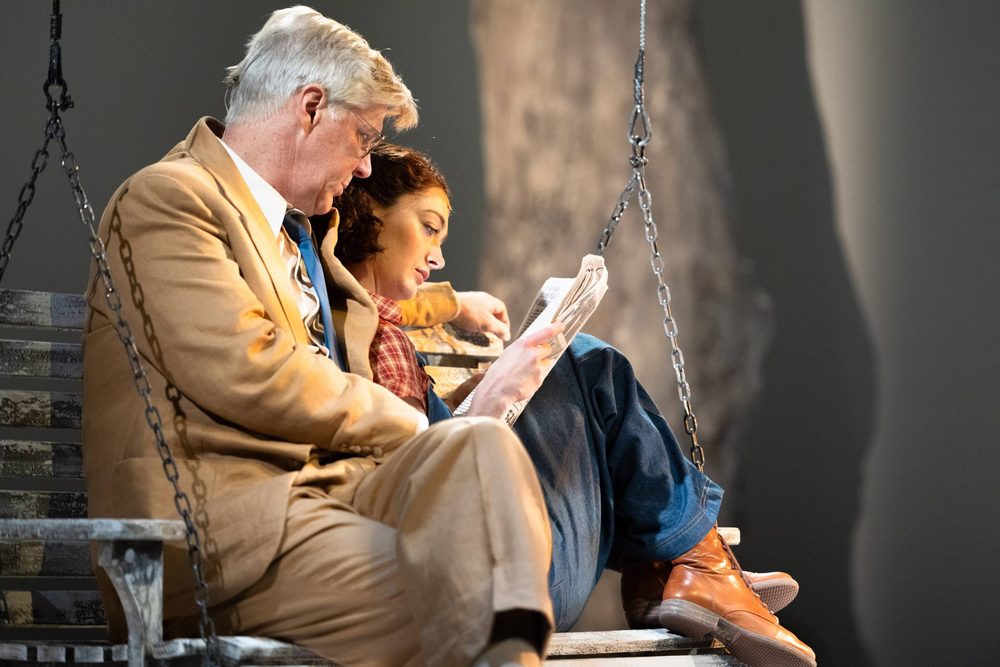
Grant and Hertzberg in “M.” Photo credit: Morganna Becker.
Presented by Exiled Theatre Company
Written by James Wilkinson
Directed by Joe Juknievich
Starring: Julia Hertzberg, Sydney Grant, Tim Hoover and Peter Tone
July 31-Aug 9, 2026
Boston Playwrights’ Theatre
Critique by Kitty Drexel
TLDR: M is a work in progress; the acting is top-notch.
BOSTON — M: Refractions from An Evil Act includes English and French dialogue. There are no subtitles. (My French is abysmal.) My impression is that we aren’t meant to understand the French dialogue in M. This helps us sympathize with M, the character… And hopefully anyone thrust into a hairy situation involving language skills they don’t possess. Including ourselves.
Playwright Wilkinson creates a comprehensive world within a David Lynchian hotel in which his characters eke out their fraught existence. He shows and tells its rules through consistent repetition. Then, à la Jean-Paul Sartre’s No Exit, Wilkinson shows us what happens if characters don’t obey those rules: Characters collapse, disappear and reappear, alcohol is replaced with more alcohol… and the maid still comes to vacuum the guest room.
Inside a Paris hotel room, M (Julia Hertzberg) finds herself questioning everything about her stay. She’s spent the night in Paris clubs and returns to a room that feels… wrong. Jolene (Sydney Grant), a hotel co-owner and housekeeper, comes to clean the room. M demands to speak to management. The Clerk (Peter Tone), a manager, receives M’s complaint. He stirs her unrest. When the Clerk goes to check a disturbance outside the hotel, M encounters Lone (Tim Hoover), an international man of mystery, before he disappears. Nothing is as it seems in this unnamed hotel with curiously few guests and only two employees. As the play summary from the Exiled Theatre site says, “Time loops, memory fractures, and the past begins to repeat itself. As identities blur and reality destabilizes, (M) must escape the hotel before she’s trapped by its history.”
New plays are works in progress. With this understanding, I say that as much as Wilkerson develops his world, he underdevelops his characters and their relationship with the audience. Most importantly, Wilkinson doesn’t tell us why we should care about them. He does tell us that Jolene and her brother, the Clerk, own and run the hotel. He tells us that M and Lone know each other somehow. Yet we don’t know why we should care that all four are having a disastrously bad time together in the hotel or why we’re watching them navigate their horrors.
Instead of telling us why we should care, Wilkinson relies too heavily on our innate empathy for our fellow humans, the characters and the actors on stage. Even villainous characters with unscrupulous moral standing can be liked by an audience if we see some of their charismatic or redeeming qualities. We don’t see many of those unless it’s through the actors’ intervention. The characters in M come so close to likeability; knowing more about them will push us into actually liking them.
Speaking of whom, the actors performed incredibly well. If thinking optimistically, Wilkinson gives them freedom to establish their own interpretations and establish inter-character stakes. M is a surreal play. These actors make bold choices which bolster the show’s chaotic vibes. Grant and Tone even found moments within M for comedy. A twist of the lips here implied their French impatience with an American tourist; a lengthy pause there implied French intelligence facing up against American audacity. Their French accents were believable. (My French is abysmal.)
Hoover grants his character, Lone, a hefty dose of likeability. We see his fear for himself as he runs through the hotel, and eventually fear for M, and translate it as sympathy. If Lone worries for M, maybe we can, too. While it’s a little too late, it helps us consider M’s potential as a character who we want to survive.
Meanwhile, we watch Hertzberg do her absolute utmost to carry this play as the title character. M is an off-putting woman – but who wouldn’t be when she’s terrified? Hertzberg delivers lines like she’s the one fighting for her life, not M. Then, when backed into a figurative and factual corner, her M turns the tables of sanity on her might-be antagonist. We’re surprised, but audiences generally are when a woman gets the upper hand over an assailant. Ask any female actor how audiences react when they do…
Wilkinson’s program note says that M is based on a disastrous three-day weekend he spent in Paris. Hollywood’s version of Paris does not resemble actual Paris. I’d argue Wilkinson’s Paris comes closer to a realistic visit. (I’ve visited Paris twice: The first time was lovely; the second included a stay in a hostel that was sometimes… Unpleasant.) Because, while Paris is very pretty on the outside, the French still live there, and French-to-American culture shock is culturally shocking on the inside.
For a play taking place in Paris, M feels very “Hotel California:” These questionable characters can leave their hotel room, but they are never, ever going home.


Presented by